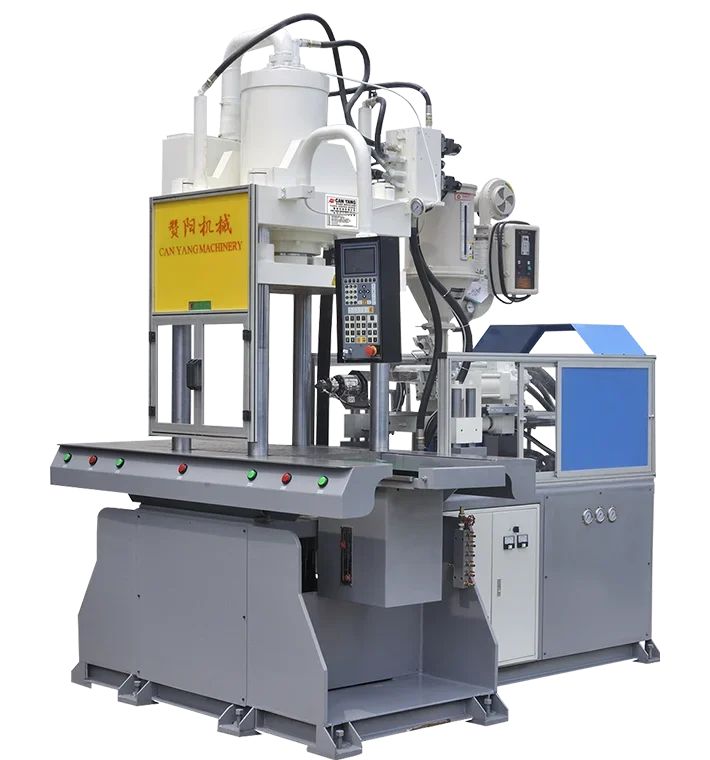
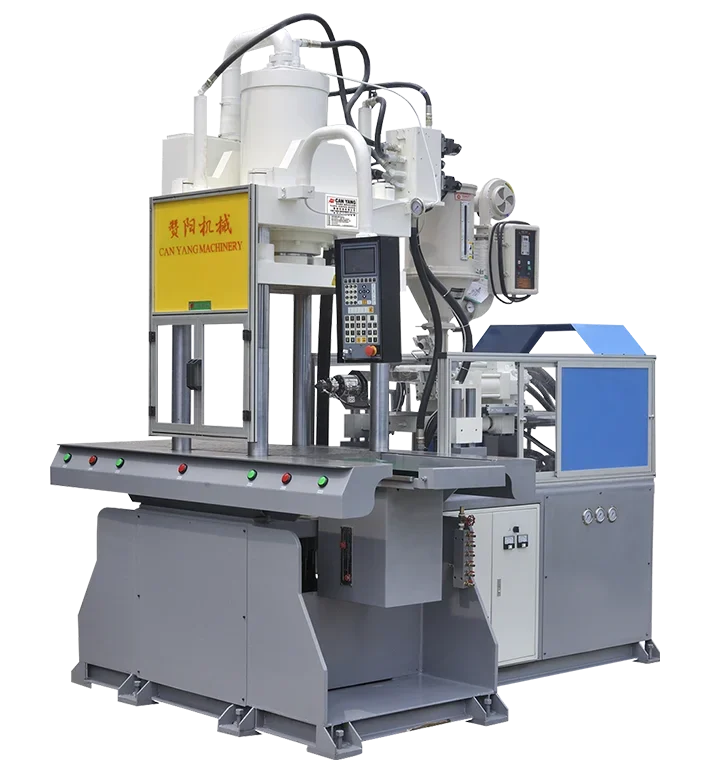
Rotary table
Rotary Table Vertical Injection Molding Machine
Loading, molding and unloading happen at different positions at the same time. For parts whose cycle can be split into parallel work.
What it suits
Small parts defined by an insert or sealing face, where one configuration and one acceptance record must repeat.
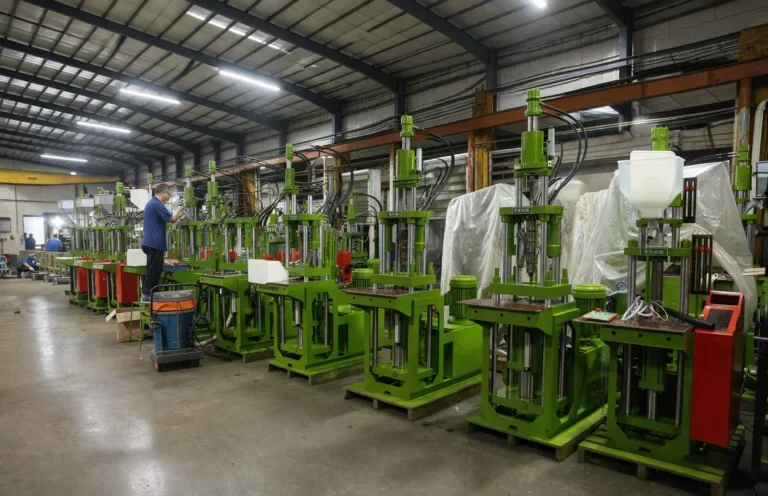
Sealed connector housings, sensor bodies, harness grommets and terminal assemblies. Solenoid overmolds, switch housings, damping mounts with bonded inserts and small brackets with molded bosses. Most come from a drawing that fixes both the insert and the sealing face.
PA6/PA66, PBT and PPA, with TPE or TPU where a seal or a flexible section is molded. Glass-filled and heat-stabilized grades are common, and the insert is usually brass, steel or aluminum.
The part is small and the insert decides whether it works, so the loading step sets both the cycle and the variation. A vertical clamp puts the nest at a fixed height in front of the operator or the gripper, opens upward, and lets the same reach, the same tray position and the same check be repeated for every shot. That repeat is what can be written down and carried to a second plant: same platform, same tool interface, same frozen settings, same acceptance run.
Harness legs or terminals are placed in the fixed half by hand or by a gripper, seated against a locating feature and confirmed by a sensor or a nest check before the clamp closes. A shaped pocket or a carrier tray blocks the wrong orientation, so the loading step itself is what keeps insert position repeatable from shot to shot.
Whether the process repeats part after part and not only at trial. Whether machine, tool interface and settings can be repeated at another site. Which level of acceptance the part needs, and whose records prove it: machine functions, the part on the tool, a quality level, or a continuous run.
Loading, molding and unloading happen at different positions at the same time. For parts whose cycle can be split into parallel work.
What it suitsWhile one table molds, the other is open for loading. The platform for parts whose insert takes as long to place as the shot takes to run.
What it suitsA harness can be pinched at the shut-off, an insert can shift when injection pressure arrives, flash can land on a sealing face and a weld line can cross it. The cycle can fall short once loading and checking are counted. What appears is decided by tool design, gate and vent layout, material and shrinkage, clamp and injection settings, insert batch consistency and the loading method. The acceptance level is agreed before the configuration is frozen, not at the end of the project.
Naming a risk is not the same as removing it: which of these applies to your part is settled in technical review.
Several lower halves travel around a fixed clamp, so loading and molding run at once on different stations.
Read the solutionAn old machine still makes the part, and the existing mold has to keep running on whatever replaces it.
Read the solutionA running part needs more machine hours, so a known configuration is repeated instead of re-engineered.
Read the solutionA photograph of the part with the insert in place, the plastic grade and the mold size start the review. Which of the points above applies to your part is settled there, not on this page.