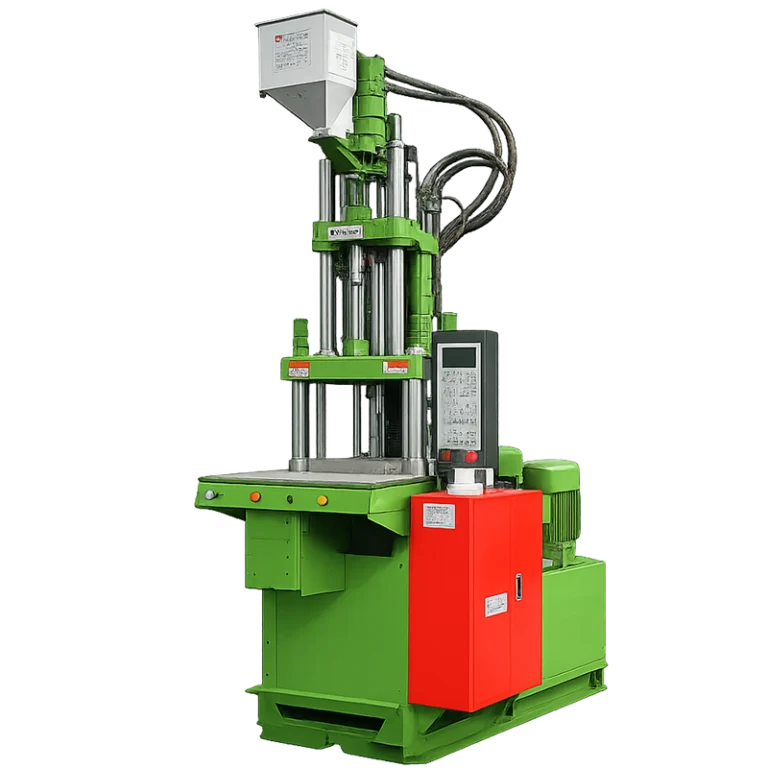
Single station
Single Station Vertical Injection Molding Machine
The open working area in its simplest form: place the insert by hand, clamp from above, take the part out. The baseline every other platform is measured against.
What it suits
The insert goes into the mold before the shot, so plastic forms around metal instead of being assembled onto it.
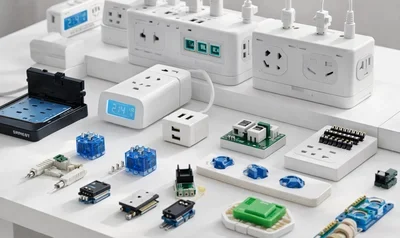
The plant either molds the metal part into the plastic or assembles it afterwards with a second operation, extra handling and a joint whose quality depends on the operator. When it molds it, the insert moves under injection pressure, flash appears where it meets the tool, and scrap collects at the loading step. What the team has to settle is whether the insert can be located and supported well enough to run as one part.
It fits when the insert has to be bonded, sealed or encapsulated by the plastic rather than joined later; when the insert can be located in a fixed half and supported against injection pressure; and when the volume justifies a tool designed around that insert instead of a post-assembly step.
It is not needed when the metal part can be pressed, glued or ultrasonically staked after molding at a lower total cost, or when the insert cannot survive the melt temperature or the clamp force. It is also a poor fit when annual volume is too small to justify a dedicated tool and a loading fixture.
The insert is placed in the fixed half, located, and its seating is checked. The clamp closes and the cavity holds the insert in position while plastic is injected around it. The part is packed and cooled with the insert still inside the tool, which is what fixes the bond and the final size. The clamp opens, the part is ejected or taken out, and the nest is checked again before the next cycle.
These are worked out with you before a structure is named. Send what you have; the rest is settled in review, before a sheet or a price exists.
We do not promise a scrap-free loading step, or a cycle figure before the tool and the material are fixed. Insert position tolerance, flash at the boundary and bond quality stay open until the mold design is reviewed, and they are settled on molded parts rather than in a quotation.
Anything not agreed in writing before the test is not part of the scope.
The open working area in its simplest form: place the insert by hand, clamp from above, take the part out. The baseline every other platform is measured against.
What it suitsLoading happens outside the clamp while the machine keeps its cycle. The first step up from a single station, without paying for a second table.
What it suitsTerminals stand upright in the lower cavity and the housing is molded around them, so each pin is visible seated.
A nut or bracket sits in the lower half while plastic is molded around it, so load stays in metal.
The first review says whether this is the structure for your part, and if it is not, which one is. Nothing here is agreed until it is written down against your own mold.